

ChatGPT’s trajectory mirrors the internet’s explosive growth post-Google launch during the dot-com boom, but with a twist the World Economic Forum never anticipated.
In their influential January 2025 “Future of Jobs Report,” the WEF predicted that AI would displace 92 million jobs while creating 170 million new ones by 2030, fundamentally reshaping work through automation and augmentation. This report, which shapes policy decisions across governments and Fortune 500 companies worldwide, became the definitive framework for understanding AI’s workplace impact.
Eight months later, by collating the latest data across multiple research sources—from Moody’s comprehensive risk and compliance studies to extensive enterprise adoption surveys covering over 1,000 companies and 14 million workers—we can now assess what the AI landscape actually looks like. While WEF correctly predicted AI would reshape work, they fundamentally underestimated the diversity of adoption patterns now reshaping both business strategy and everyday life.
Two and a half years after ChatGPT’s launch, we’re witnessing something unprecedented. AI platforms are naturally segmenting into consumer lifestyle tools and specialised enterprise solutions—a bifurcation that challenges core assumptions about how artificial intelligence would integrate into society.
Notepad Summary of the Report
What WEF Got Right (And Spectacularly Wrong)
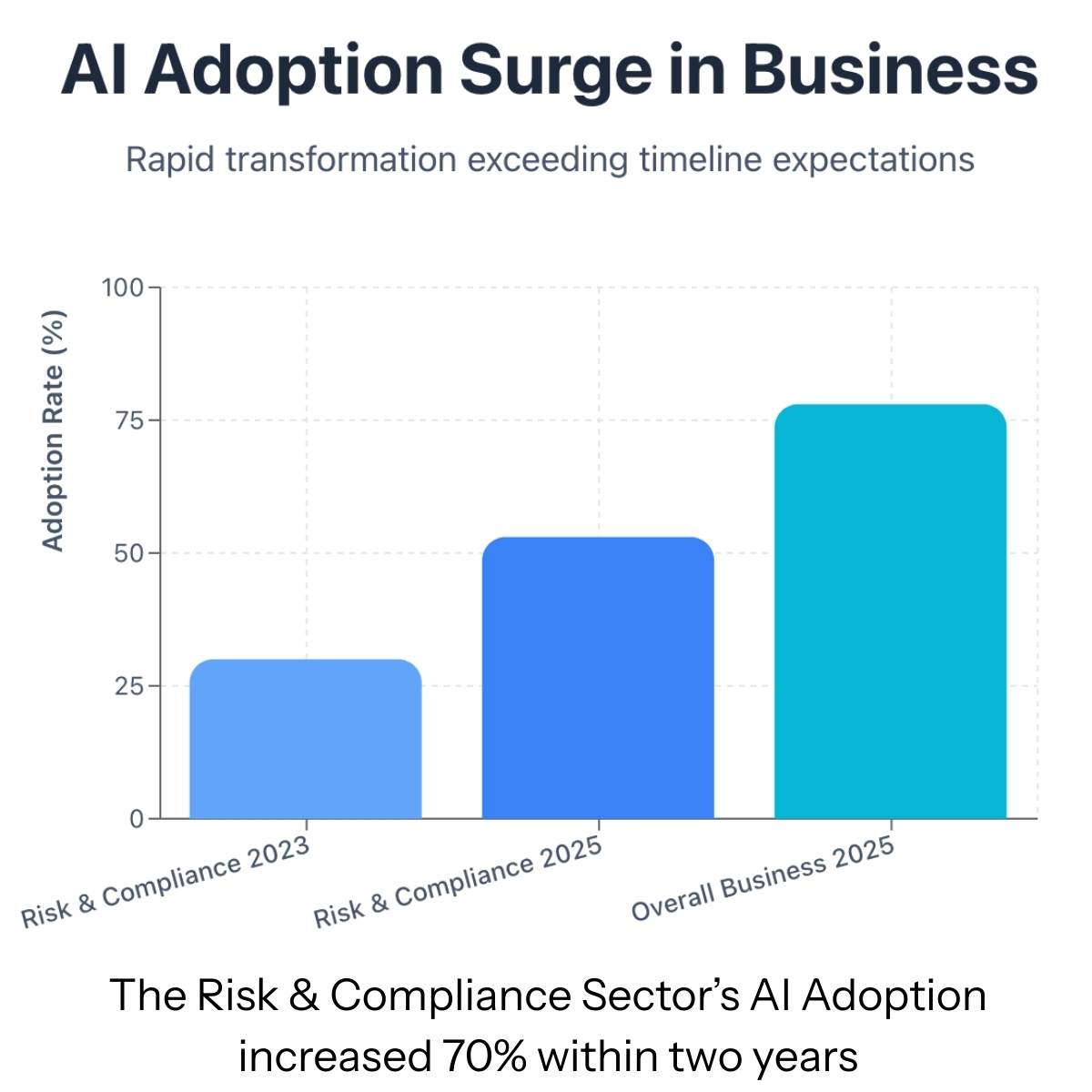
The World Economic Forum’s 2025 predictions proved remarkably prescient in some areas while missing crucial dynamics entirely.
Their forecast that AI would rapidly transform business proved accurate, with 78% of businesses already using AI by mid-2025, far exceeding their timeline expectations. Recent data from risk and compliance sectors alone shows 53% actively using AI, a dramatic jump from just 30% in 2023. The job market has remained resilient as they predicted, with new roles emerging to offset displaced ones.
Where they succeeded was recognising AI’s transformative potential. Where they failed was understanding how that transformation would actually unfold.
WEF assumed AI would be a general-purpose workplace tool that would boost productivity through task automation. The reality reveals something far more complex and interesting. ChatGPT has evolved into a consumer advisory platform with 73% non-work usage, while Claude has solidified as an enterprise technical solution focused heavily on coding and complex analysis.
This natural market segmentation was entirely unforeseen. More significantly, users consistently prefer AI as an advisor rather than an automator. Nearly half of all interactions involve seeking guidance and information (“Asking” behaviour) rather than requesting task completion (“Doing” behaviour), and these advisory interactions receive consistently higher satisfaction ratings.
The Shadow AI Economy: The Real Enterprise Revolution
Behind the disappointing official enterprise deployment numbers lies a surprising reality that WEF completely missed: AI is already transforming work, just not through formal channels. The emergence of what researchers now call the “Shadow AI Economy” reveals the true scale of workplace transformation.
While only 40% of companies report purchasing official LLM subscriptions, workers from over 90% of surveyed companies use personal AI tools for work tasks regularly. In fact, almost every single knowledge worker now uses an LLM in some form for their job – they’re just doing it through personal ChatGPT accounts, Claude subscriptions, and other consumer tools, often without IT knowledge or approval.
The scale is remarkable. Shadow AI users report using LLMs multiple times daily throughout their weekly workload through personal tools, while their companies’ official AI initiatives remain stalled in pilot phase. This creates a fascinating paradox: the same professionals who integrate AI tools into personal workflows describe enterprise AI systems as unreliable and inflexible.
This shadow economy demonstrates that individuals can successfully cross what researchers term the “GenAI Divide” when given access to flexible, responsive tools. The businesses that recognise this pattern and build on it represent the future of enterprise AI adoption. Forward-thinking businesses are beginning to bridge this gap by learning from shadow usage and analysing which personal tools deliver value before procuring enterprise alternatives.
The Demographic Revolution Nobody Saw Coming
ChatGPT achieved one of the fastest demographic reversals in technology history, transforming from 80% male early adopters to 52% female users in just 2.5 years. Meanwhile, 46% of all messages come from users aged 18-25, suggesting AI’s impact is generationally concentrated rather than uniformly distributed across age groups.
This demographic shift has profound implications for how we understand technology adoption. Unlike previous enterprise technologies that filtered down to consumers, AI platforms are being shaped by consumer behaviour from young, increasingly female user bases who are using these tools for education, personal guidance, and decision support.
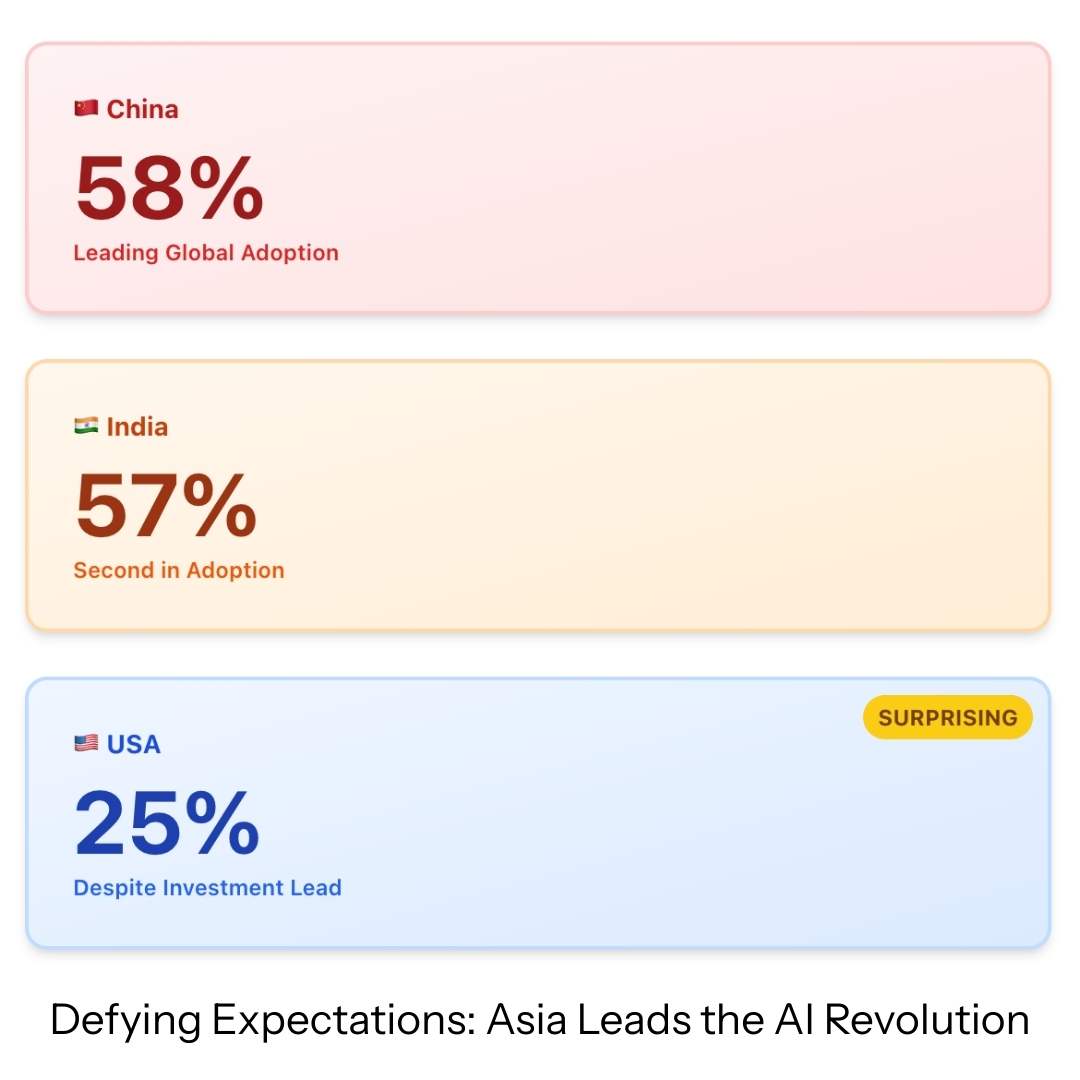
The geographic patterns tell an equally surprising story. While WEF assumed Western leadership in AI adoption, China leads at 58% adoption, India at 57%, while the US lags at only 25% despite leading in investment dollars. This pattern holds across both consumer and enterprise contexts—Asia-Pacific companies show 60% AI adoption versus Europe at 46%. This suggests that cultural acceptance and supportive policies matter more than pure innovation spending.
The Learning Gap That Defines Success and Failure
The most critical insight missing from WEF’s analysis is what researchers now identify as the fundamental “learning gap” that separates successful AI adoption from failed implementations.
Users prefer ChatGPT and consumer AI tools over expensive enterprise systems not because of features or interfaces, but because consumer tools adapt, remember context, and evolve with use. Enterprise AI systems fail precisely because they lack these learning capabilities. Even when built on identical underlying models, enterprise implementations that don’t learn, integrate poorly with workflows, or require extensive manual context each time see dramatic user resistance.
This explains the striking contradiction in user behaviour: professionals who use ChatGPT daily for personal tasks become highly critical of static enterprise tools. They know what effective AI feels like, making them less tolerant of systems that break in edge cases, can’t be customised to specific workflows, require too much manual context, and don’t learn from feedback.
The barriers keeping businesses trapped on the wrong side of the GenAI Divide reflect this learning gap:
● Model quality concerns emerge as the second-highest barrier, not because the models are inferior, but because they lack contextual memory.
● Poor user experience stems from systems that can’t adapt to evolving workflows.
● Unwillingness to adopt new tools increases when those tools feel static compared to consumer alternatives.
Industry-Specific Adoption Reality
Recent research reveals that AI transformation varies dramatically by industry, with clear patterns that validate some WEF predictions while contradicting others.
High Disruption Industries:
Technology: New challengers gaining ground (Cursor vs GitHub Copilot); fundamental workflow shifts
Media & Telecom: Rise of AI-native content; shifting advertising dynamics; incumbents adapting.
Moderate Impact Industries:
Professional Services: Efficiency gains; client delivery models largely unchanged.
Financial Services: Significant backend automation; customer relationships stable.
Minimal Disruption Industries:
Healthcare & Pharma: Documentation and transcription pilots; clinical models unchanged.
Advanced Industries: Maintenance pilots; no major supply chain shifts.
Energy & Materials: Near-zero adoption; minimal experimentation.
Within financial services, the risk and compliance sector shows particularly rapid adoption, with fintech leading at 74% usage, asset management at 73%, and professional services at 60%. Traditional banks lag at 50%, while government adoption remains lowest at 35%.
Data Quality: The Hidden Adoption Predictor
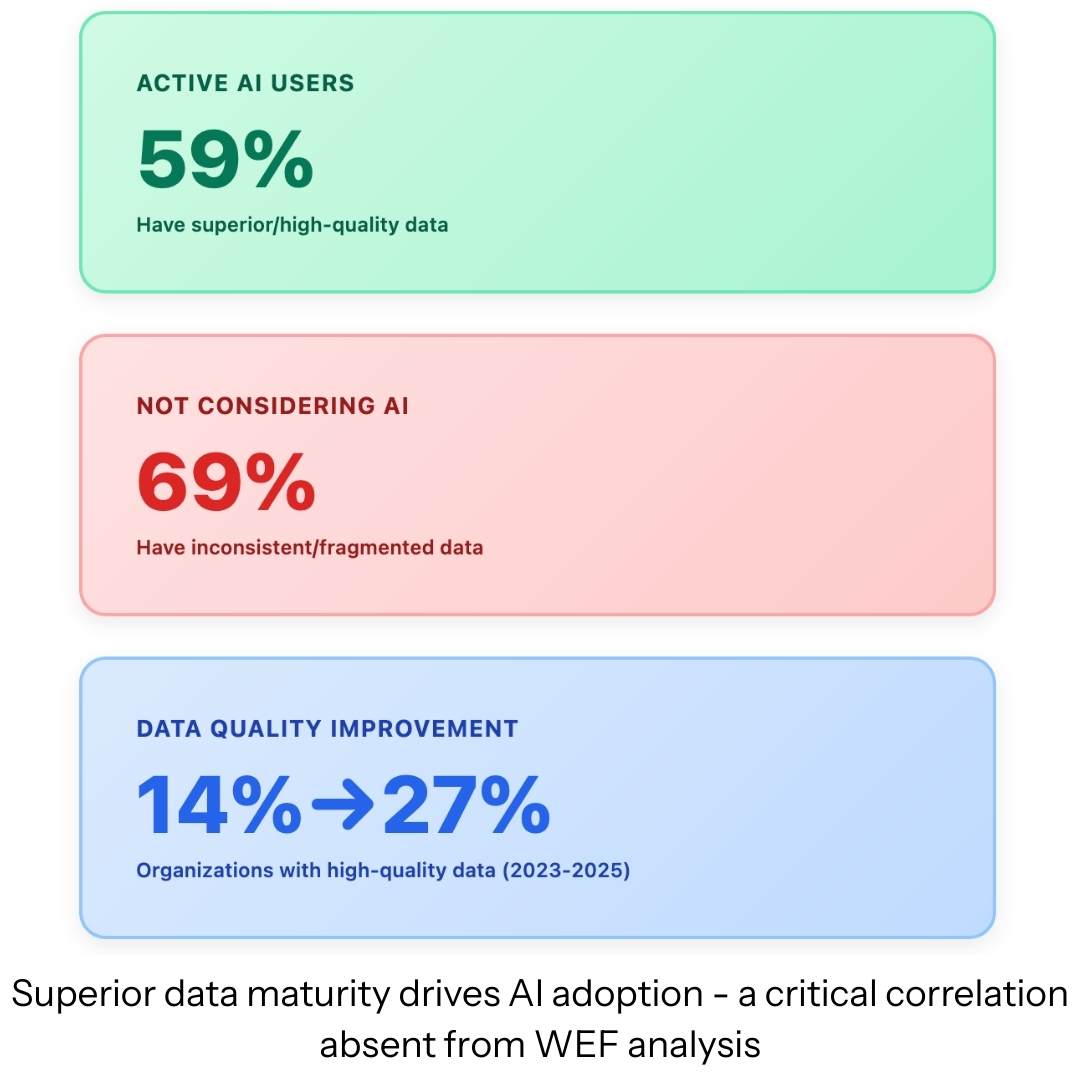
One of the most significant findings absent from WEF’s analysis is the strong correlation between data maturity and AI adoption success. Organisations with superior or high-quality data show dramatically higher AI adoption rates.
Among active AI users, 59% report having superior or high-quality data. Conversely, 69% of businesses not considering AI use report their data as inconsistent, fragmented, or unstructured. The percentage of organisations rating their data as high quality increased from just 14% in 2023 to 27% in 2025.
This correlation helps explain why Large Language Models (LLMs) see higher adoption rates than other AI technologies—they can process unstructured information in ways that weren’t possible before, essentially bridging data quality gaps that prevented earlier AI implementations.
The Internet Parallel: Understanding Where We Are Now
The ChatGPT adoption curve mirrors the internet’s transformation after Google’s launch in 1998-2001, following a predictable but fascinating pattern.
The early phase focused on business efficiency and communication, similar to initial AI workplace deployments. Then came the consumer revolution, where Google’s search transformed the internet from business tool to everyday utility. ChatGPT is experiencing this same pivot, from work productivity tool to life assistant.
Next came platform divergence, where different internet platforms found specialised niches. eBay dominated commerce, Amazon owned retail, Yahoo became the portal. We’re seeing identical AI platform specialisation today, with each major AI tool carving out distinct user bases and use cases.
Finally, the internet became essential daily infrastructure. ChatGPT is entering this phase for consumer advisory services, becoming the go-to resource for everyday decision-making, learning, and problem-solving.
The Investment Reality vs ROI Paradox
Current AI investment patterns reveal a critical misallocation that WEF failed to predict. While 70% of GenAI budgets flow to sales and marketing functions, back-office automation often yields superior returns.
Sales & Marketing Wins:
Lead qualification speed: 40% faster.
Customer retention: 10% improvement through AI-powered follow-ups.
Revenue growth for top-quartile GenAI startups: $1.2M within 6-12 months.
Back-Office Wins (Higher ROI):
BPO elimination: $2-10M annually in customer service and document processing.
Agency spend reduction: 30% decrease in external creative and content costs.
Risk management savings: $1M annually in outsourced compliance work.
This investment bias reflects measurement challenges rather than actual value creation. Sales metrics align directly with board-level KPIs, while back-office efficiencies—fewer compliance violations, streamlined workflows, accelerated processes—remain harder to quantify and present to executives.
Strategic Implications for Business
This adoption reality creates fundamentally different strategic requirements for organisations depending on which AI economy they’re operating within.
For consumer-facing organisations, the most successful AI applications position themselves as advisors and research assistants rather than task replacers. Users want guidance for better decision-making, not complete automation. Marketing approaches must recognise that ChatGPT users expect consumer-friendly, educational experiences while Claude users expect technical, enterprise-focused solutions.
The demographic targeting requires complete reframing. The female-majority user base and youth concentration demand rethinking AI marketing demographics and messaging strategies that move away from traditional enterprise technology approaches.
For enterprise strategy, success now depends more on effective AI implementation than pure innovation investment. Businesses must acknowledge and integrate shadow AI usage rather than fighting it. The most successful companies analyse which personal tools deliver value, then provide secure enterprise alternatives that maintain the learning capabilities users expect.
Asia-Pacific markets lead through supportive policies and cultural acceptance, not just research and development spending.
Organisations finding success focus on human-AI collaboration for decision support rather than wholesale job replacement.
The data reveals a bifurcated economy emerging. Large enterprises with implementation capabilities achieve twice the adoption rates of smaller businesses, potentially creating permanent competitive advantages rather than the democratised AI access many predicted. Only about one-third of small and medium enterprises show meaningful AI adoption, creating a two-tier system WEF didn’t anticipate.
Workforce Impact: The Selective Reality
The research reveals that AI’s workforce impact is manifesting through selective displacement of previously outsourced functions and constrained hiring patterns, but not through broad-based layoffs that WEF anticipated.
GenAI-driven workforce reductions concentrate in functions historically treated as non-core business activities: customer support operations (5-20% reduction), administrative processing, and standardised development tasks. These roles exhibited vulnerability prior to AI implementation due to their outsourced status and process standardisation.
Notably, these workforce changes come without material team structure or budget changes. Instead, ROI emerges from reduced external spending—eliminating BPO contracts, cutting agency fees, and replacing expensive consultants with AI-powered internal capabilities.
Industry-specific hiring expectations reveal clear patterns. In sectors showing minimal AI disruption (Healthcare, Energy, Advanced Industries), executives report no anticipated hiring reductions. Conversely, in Technology and Media sectors where GenAI demonstrates measurable impact, over 80% of executives anticipate reduced hiring volumes within 24 months.
Seven Critical Business Insights
1. Shadow AI integration is essential. Organisations must acknowledge that employees are already using personal AI tools and build secure enterprise alternatives that maintain learning capabilities rather than fighting informal adoption.
2. Platform specialisation appears permanent rather than temporary. Businesses shouldn’t expect a single AI solution for all use cases. Consumer-facing applications should focus on advisory and educational functions, while enterprise solutions should emphasise technical specialisation and automation.
3. The advisory economy represents AI’s highest value proposition. This lies in improving human decision-making rather than replacing human tasks. Organisations succeeding with AI invest in collaborative workflows that enhance judgment rather than eliminate jobs.
4. Data quality predicts adoption success. Businesses with superior data achieve dramatically higher AI adoption rates. Investing in data infrastructure may yield higher returns than investing in AI tools.
5. Demographics are driving adoption in unexpected directions. Youth and female users are pushing consumer AI adoption in ways traditional tech adoption models didn’t predict. Product development and marketing must account for these new primary user demographics.
6. Implementation capabilities matter more than innovation budgets. Countries and companies succeeding with AI focus on effective deployment and cultural integration rather than pure technological advancement. Supportive policies and change management matter more than research spending.
7. Back-office automation may offer superior ROI despite lower investment. While sales and marketing capture attention and funding, administrative and support functions show more dramatic and sustainable returns for organisations willing to look beyond obvious use cases.
Looking Toward 2030
WEF’s core 2030 projections remain directionally accurate but require significant reframing. Their prediction of 170 million jobs created and 92 million displaced, resulting in 78 million net new positions, still seems plausible. However, the mechanism differs substantially from their assumptions.
Job creation is happening through collaborative human-AI workflows rather than simple displacement-replacement cycles. The 39% of workers whose skills will transform by 2030 need collaborative decision-making abilities rather than technical automation expertise. Economic value is being distributed through enhanced consumer decision-making and quality-of-life improvements rather than measurable workplace productivity gains alone.
The learning gap will determine which businesses thrive. Companies that successfully bridge the divide between consumer AI expectations and enterprise requirements—providing tools that adapt, remember, and evolve—will capture disproportionate value. Those treating AI as static automation tools will find themselves competing against both AI-enhanced competitors and their own employees’ shadow AI usage.
The Bottom Line
WEF correctly identified AI’s transformative potential but systematically underestimated adoption diversity and missed the critical role of the shadow AI economy. The reality emerging by 2025 involves more geographic variation, more demographic concentration, more platform specialisation, and more informal adoption than their framework anticipated.
For organisations, success requires understanding which AI economy you’re operating in—the broad consumer advisory market or the concentrated enterprise automation space. The strategies, demographics, and value propositions for each are fundamentally different.
Most critically, organisations must acknowledge that the AI transformation is already happening through personal tools and shadow usage. The choice isn’t whether to adopt AI, but whether to provide secure, enterprise-grade alternatives that match the learning capabilities employees already expect from consumer tools.
The internet changed everything, but not in the way early observers expected. AI is following the same pattern—transformative impact, but through consumer adoption, advisory applications, and informal workplace integration rather than formal workplace automation alone. Understanding this distinction will determine which organisations thrive in the AI economy versus those still preparing for a workplace transformation that’s already taking a different path.
References
Core Data Sources
AI Usage Research
OpenAI Research
Chatterji, A., Cunningham, T., Deming, D., Hitzig, Z., Ong, C., Shan, C., & Wadman, K. (2025). “How People Use ChatGPT.” OpenAI Research Paper, September 15, 2025.
Anthropic Research
Handa, K., Tamkin, A., McCain, M., et al. (2025). “Which Economic Tasks are Performed with AI? Evidence from Millions of Claude Conversations.” Anthropic Research.
Economic and Labor Market Analysis
World Economic Forum
World Economic Forum (2025). “The Future of Jobs Report 2025.” WEF Publications. https://www.weforum.org/publications/the-future-of-jobs-report-2025/
OECD Analysis
OECD (2025). “Emerging Divides in the Transition to Artificial Intelligence.” OECD Employment Outlook 2025. https://www.oecd.org/en/publications/2025/07/oecd-employment-outlook-2025
International Labour Organization (ILO)
ILO (2024). “Generative AI and Jobs: A Global Analysis of Potential Effects on Job Quantity and Quality.”
Enterprise Adoption Studies
McKinsey & Company
McKinsey (2024). “The State of AI in Early 2024.” McKinsey Quarterly. https://www.mckinsey.de/capabilities/quantumblack/our-insights/the-state-of-ai-2024
IBM Global AI Adoption Index
IBM (2024). “Data Suggests Growth in Enterprise Adoption of AI is Due to Widespread Deployment by Early Adopters.” IBM Newsroom, January 10, 2024.
Lightcast Labor Market Analysis
Lightcast (2025). “The Generative AI Job Market: 2025 Data Insights.” https://lightcast.io/resources/blog/the-generative-ai-job-market-2025-data-insights
Shadow AI Economy Research
Primary Shadow AI Studies
MIT Project NANDA (2025)
MIT Sloan Management Review & BCG collaboration
Sample: 300+ organizations, 153 business leaders
Finding: 90% of employees use personal AI tools; 40% of companies have official AI subscriptions
Source: Fortune, August 2025
URL: https://fortune.com/2025/08/19/shadow-ai-economy-mit-study-genai-divide-llm-chatbots/
Microsoft Work Trend Index (2024)
Sample: 31,000 knowledge workers across 31 countries
Finding: 75% of knowledge workers use AI at work; 78% bring their own AI tools
URL: https://www.microsoft.com/en-us/worklab/work-trend-index/ai-at-work-is-here-now-comes-the-hard-part
Cyberhaven Labs (2024)
Sample: 3 million workers (telemetry data)
Finding: 73.8% of workplace ChatGPT accounts are non-corporate; 27.4% of corporate data uploaded is sensitive
URL: https://www.cyberhaven.com/blog/shadow-ai-how-employees-are-leading-the-charge-in-ai-adoption-and-putting-company-data-at-risk
Software AG Global Study (2024)
Sample: 6,000 workers across US, UK, and Germany
Finding: 50% use shadow AI tools
URL: https://newscenter.softwareag.com/en/news-stories/press-releases/2024/1022-half-of-all-employees-use-shadow-ai.html
Fast Company/CybSafe Study (2025)
Sample: 32,000 workers across 47 countries
Finding: 48% uploaded sensitive data to public AI; 40% would violate policy to save time
URL: https://www.fastcompany.com/91325181/ai-work-survey-research
Also: https://theconversation.com/major-survey-finds-most-people-use-ai-regularly-at-work-but-almost-half-admit-to-doing-so-inappropriately-255405
Netskope Threat Intelligence (2024-2025)
Cloud and Threat Reports on AI Apps in Enterprise
Finding: 60% of enterprise genAI use through personal accounts
URL: https://www.netskope.com/netskope-threat-labs/cloud-threat-report/july-2024-ai-apps-in-the-enterprise
2025 Report: https://www.netskope.com/resources/reports-guides/cloud-and-threat-report-shadow-ai-and-agentic-ai-2025
Security and Risk Analysis
IBM Cost of Data Breach Report (2024)
Finding: Shadow AI adds $670K to breach costs; 1 in 5 organizations breached due to shadow AI
URL: https://www.networkworld.com/article/4030807/ibm-cost-of-u-s-data-breaches-reaches-all-time-high-and-shadow-ai-isnt-helping.html
Also: https://venturebeat.com/security/ibm-shadow-ai-breaches-cost-670k-more-97-of-firms-lack-controls
IBM Institute for Business Value
“The Enterprise Guide to AI Governance”
Finding: 34% of organizations have AI governance policies
URL: https://www.ibm.com/thought-leadership/institute-business-value/en-us/report/ai-governance
Palo Alto Networks
“What Is Shadow AI? How It Happens and What to Do About It”
URL: https://www.paloaltonetworks.com/cyberpedia/what-is-shadow-ai
Cloud Security Alliance (2025)
“AI Gone Wild: Why Shadow AI Is Your IT Team’s Worst Nightmare”
URL: https://cloudsecurityalliance.org/blog/2025/03/04/ai-gone-wild-why-shadow-ai-is-your-it-team-s-worst-nightmare
KnowBe4 Security Blog
“Shadow AI: A New Insider Risk for Cybersecurity Teams to Tackle Now”
URL: https://blog.knowbe4.com/shadow-ai-a-new-insider-risk-for-cybersecurity-teams-to-tackle
Academic Research
Technology Adoption Studies
Bick, Blandin & Deming (2024)
Bick, A., Blandin, A., & Deming, D.J. (2024). “The Rapid Adoption of Generative AI.” NBER Working Paper 32966, National Bureau of Economic Research.
Humlum & Vestergaard (2025)
Humlum, A., & Vestergaard, E. (2025). “The Unequal Adoption of ChatGPT Exacerbates Existing Inequalities among Workers.” Proceedings of the National Academy of Sciences, 122(1).
Collis & Brynjolfsson (2025)
Collis, A., & Brynjolfsson, E. (2025). “AI’s Overlooked $97 Billion Contribution to the Economy.” Wall Street Journal, August 2025.
Case Studies & Incidents
Samsung ChatGPT Incident (2023)
Reported by: Cyberhaven, Prompt Security, multiple outlets
Engineers leaked confidential source code to ChatGPT
Estimated loss: £1M+
URL: https://www.prompt.security/blog/8-real-world-incidents-related-to-ai
McKinsey Lilli Platform
Internal AI governance case study
72% employee adoption, 30% time savings
URL: https://digitaldefynd.com/IQ/ways-mckinsey-is-using-ai/
Compliance & Regulatory Framework
Data Protection & Privacy
NetApp: Data Compliance Regulations (HIPAA, GDPR, PCI-DSS)
URL: https://www.netapp.com/blog/data-compliance-regulations-hipaa-gdpr-and-pci-dss/
EU AI Act
European Commission Digital Strategy
URL: https://digital-strategy.ec.europa.eu/en/policies/regulatory-framework-ai
European Parliament overview: https://www.europarl.europa.eu/topics/en/article/20230601STO93804/eu-ai-act-first-regulation-on-artificial-intelligence
AI Regulation Trends (US/UK/EU)
MetricStream analysis
URL: https://www.metricstream.com/blog/ai-regulation-trends-ai-policies-us-uk-eu.html
Technical Controls & Detection
Cloudflare CASB for AI
“ChatGPT, Claude, & Gemini security scanning with Cloudflare CASB”
URL: https://blog.cloudflare.com/casb-ai-integrations/
Microsoft Purview DLP
Data Loss Prevention documentation
URL: https://learn.microsoft.com/en-us/purview/dlp-learn-about-dlp
Metomic
“ChatGPT DLP (Data Loss Prevention): The Ultimate Guide”
URL: https://www.metomic.io/resource-centre/the-ultimate-guide-to-data-loss-prevention-in-chatgpt
Infoblox DNS Security
“Blocking Shadow AI Using Protective DNS”
URL: https://blogs.infoblox.com/security/blocking-shadow-ai-using-protective-dns-simple-yet-powerful/
LayerX Security
“Browser Extension Audit and Remediation: Key Enterprise Insights”
URL: https://layerxsecurity.com/learn/browser-security/audit-and-remediation/
Wiz Academy
“What is Shadow AI? Why It’s a Threat and How to Embrace and Manage It”
URL: https://www.wiz.io/academy/shadow-ai
Training & Best Practices
Great Place to Work
“How the 100 Best Companies Are Training Their Workforce for AI”
Sample: Top 100 companies, AI training approaches
URL: https://www.greatplacetowork.com/resources/blog/100-best-training-workforce-ai
Nielsen Norman Group
“AI Improves Employee Productivity by 66%”
Research on productivity gains
URL: https://www.nngroup.com/articles/ai-tools-productivity-gains/
Industry Analysis & Commentary
Demographic & Social Impact
Pew Research Center (2025)
“Americans’ Use of ChatGPT Is Ticking Up.”
Independent demographic validation of US adoption patterns
Stanford HAI (Human-Centered AI)
Stanford University (2025). “AI Index Report 2025: Measuring Trends in AI.”
Comprehensive annual benchmark for AI adoption, investment, and capability metrics
Business Strategy Analysis
Gartner Technology Trends
Gartner (2024). “Hype Cycle for Artificial Intelligence, 2024.” Gartner Research.
Boston Consulting Group
BCG (2024). “AI at Work: What People Are Saying.” BCG Henderson Institute.
Benedict Evans
Evans, B. (2024). “Generative AI: The New S-Curve.” Benedict Evans Blog.
a16z (Andreessen Horowitz)
Andreessen Horowitz (2024). “The State of Generative AI in the Enterprise.”
News & Analysis
Axios (2025)
“Workers use ChatGPT, Gemini, Claude in secret”
URL: https://www.axios.com/2025/05/29/secret-chatgpt-workplace
TechTarget
“Shadow AI: How CISOs can regain control in 2025 and beyond”
URL: https://www.techtarget.com/searchsecurity/tip/Shadow-AI-How-CISOs-can-regain-control-in-2026
The Cyber Express (2025)
“Shadow AI In 2025: The Silent Threat Reshaping Cybersecurity”
URL: https://thecyberexpress.com/shadow-ai-in-2025-a-wake-up-call/
Infosecurity Magazine
“Why Shadow AI Is the Next Big Governance Challenge for CISOs”
URL: https://www.infosecurity-magazine.com/news-features/shadow-ai-governance-cisos/
UpGuard
“The Shadow AI Data Leak Problem No One’s Talking About”
URL: https://www.upguard.com/blog/shadow-ai-data-leak
Platform-Specific Analysis
SimilarWeb
SimilarWeb (2025). “Digital Research Intelligence: AI Chatbot Traffic Analysis.”
Sensor Tower
Sensor Tower (2025). “Mobile App Intelligence: AI Assistant Apps Performance.”
Geographic & International Context
China Academy of Information and Communications Technology
CAICT (2024). “White Paper on Artificial Intelligence Development.”
European Commission
European Commission (2024). “Study on the Impact of Artificial Intelligence on the EU Labour Market.”
Research Methodology
This analysis cross-referenced multiple independent studies to validate claims, prioritising:
- Peer-reviewed academic research
- Enterprise telemetry data (3M+ workers)
- Large-sample surveys (30,000+ participants)
- Official government and institutional reports
- Verified security incident data
All sources accessed: November-December 2025

Related Posts

Power Consolidates Quietly
Google's control over search happened incrementally. AI is accelerating the…

5 AI Marketing Agents You Can Deploy Today
The real question isn't whether to use AI marketing agents—it's how to use them…

Why 99% of Companies Fail at AI Implementation
Most businesses are rushing into AI—but only 1% have actually integrated it…